Leadership development
Manager development is your highest-impact investment. Coaching is what makes it work.

Every Head of Learning and Talent Development leader is having the same conversation with their CPO this quarter: what's the plan for retaining top talent? And the plan almost always runs through one person, the manager.
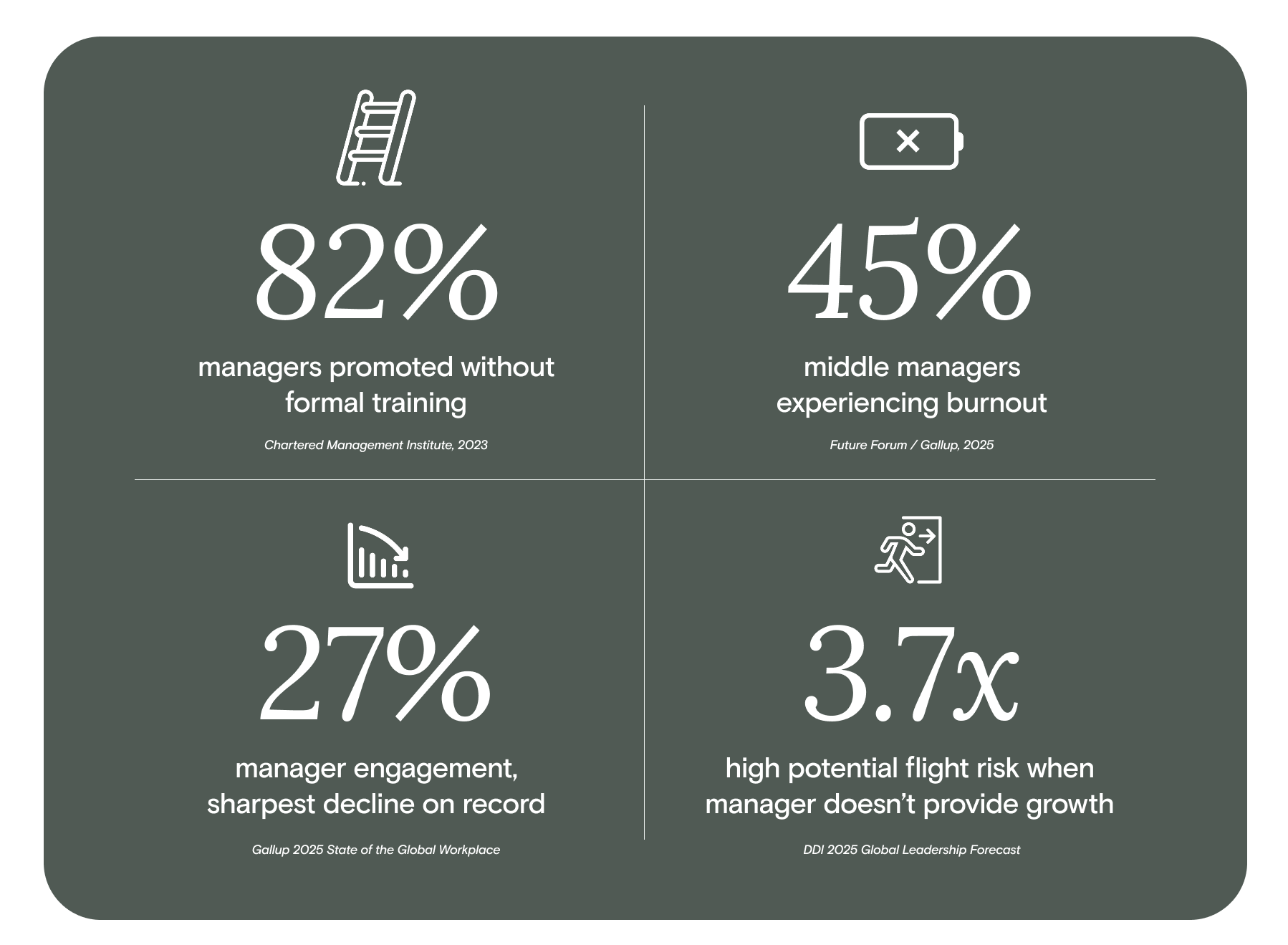
82 percent of managers are promoted into the role without any formal training, and middle-manager burnout sits at 45 percent. And the programs L&D teams have been running to close the gap—cohort-based leadership curricula, workshops, one-off manager training—aren't changing what managers do day to day.
The conversation is especially urgent in tech right now. The talent war that started in AI and engineering has spread to every function. Sales leaders, recruiters, and operations managers with relevant experience are being poached at rates most companies can't sustainably match. Compensation matters, but you can't out-pay the market forever. Stretch assignments help, but they don't scale. What moves retention at this level is whether a top performer trusts the person they report to, and whether that person is any good at the job of managing.
Most leadership development isn't producing behavior change — and the research is clear about why
We run a performance coaching company, so take our enthusiasm with a grain of salt. The case we want to make isn't ours, though. It comes from Gartner, ATD, and recent academic research, and it lands in one place: most of what companies spend on leadership development isn't producing behavior change.
In October 2024, Gartner surveyed more than 800 HR leaders. Three quarters of their organizations had made significant updates to their leadership development programs. More than half had increased spending. And they weren't seeing results. Gartner's analysis went further: traditional leadership development formats (seminars, lectures, classroom workshops) have a negative effect on development.
The transfer-of-learning research says the same thing in a different way. Companies spend billions on workplace learning every year, according to ATD's 2025 State of the Industry report. Only 10 to 20 percent of what people learn in formal programs ever gets applied on the job. That includes the LMS platforms and content libraries most companies treat as the backbone of their development strategy. L&D leaders have been calling satisfaction surveys "happy sheets" for years, and they know Kirkpatrick Level 1 (did they like it?) is where most programs stop measuring.
What the academic research adds is the other half of the story. Dozens of recent controlled studies (1, 2, 3) find that coaching produces measurable behavior change in managers, at effect sizes that match or exceed what traditional development formats produce. Knowledge transfer teaches. Coaching translates what's been taught into what managers do. It's the behavioral mechanism your other L&D investments are missing.
The cost of the status quo
The behavioral gap isn't an abstract research finding. It's showing up in the numbers every talent leader is already watching.
Gallup's 2025 State of the Global Workplace report put manager engagement at 27 percent, the sharpest decline on record, and pinned the productivity cost at $438 billion globally. When managers disengage, their teams follow.
DDI's 2025 Global Leadership Forecast fills in the rest of the picture. Trust in managers has fallen from 46 percent to 29 percent since 2022. High-potential departure intentions have climbed from 13 percent to 21 percent over the same period. HiPo talent is 3.7 times more likely to leave when their manager doesn't provide growth. And the companies investing in coaching cultures, where coaching extends beyond the executive team to managers at every level, are 1.5 times more likely to rank among the top financial performers in their industries.
Most L&D budgets are short on the mechanism that translates development into behavior change. Coaching, done well, is that mechanism.
What good coaching looks like for leaders
The research explains why coaching works. It doesn't explain why some coaching programs deliver results and others don't.
At Mento, we've been tracking outcomes across more than 100 customers using a matched-pair methodology, comparing the same manager at baseline and again after working with a coach. The pattern is consistent. 93 percent of managers improve in at least one core area of performance, leadership, or management effectiveness. 98 percent of participants say coaching is worth the investment. The numbers are change scores, not satisfaction scores. Every manager rated themselves against their own baseline, which is the kind of data your CFO actually wants. It's also the answer to the leadership development ROI question many L&D teams struggle to give.
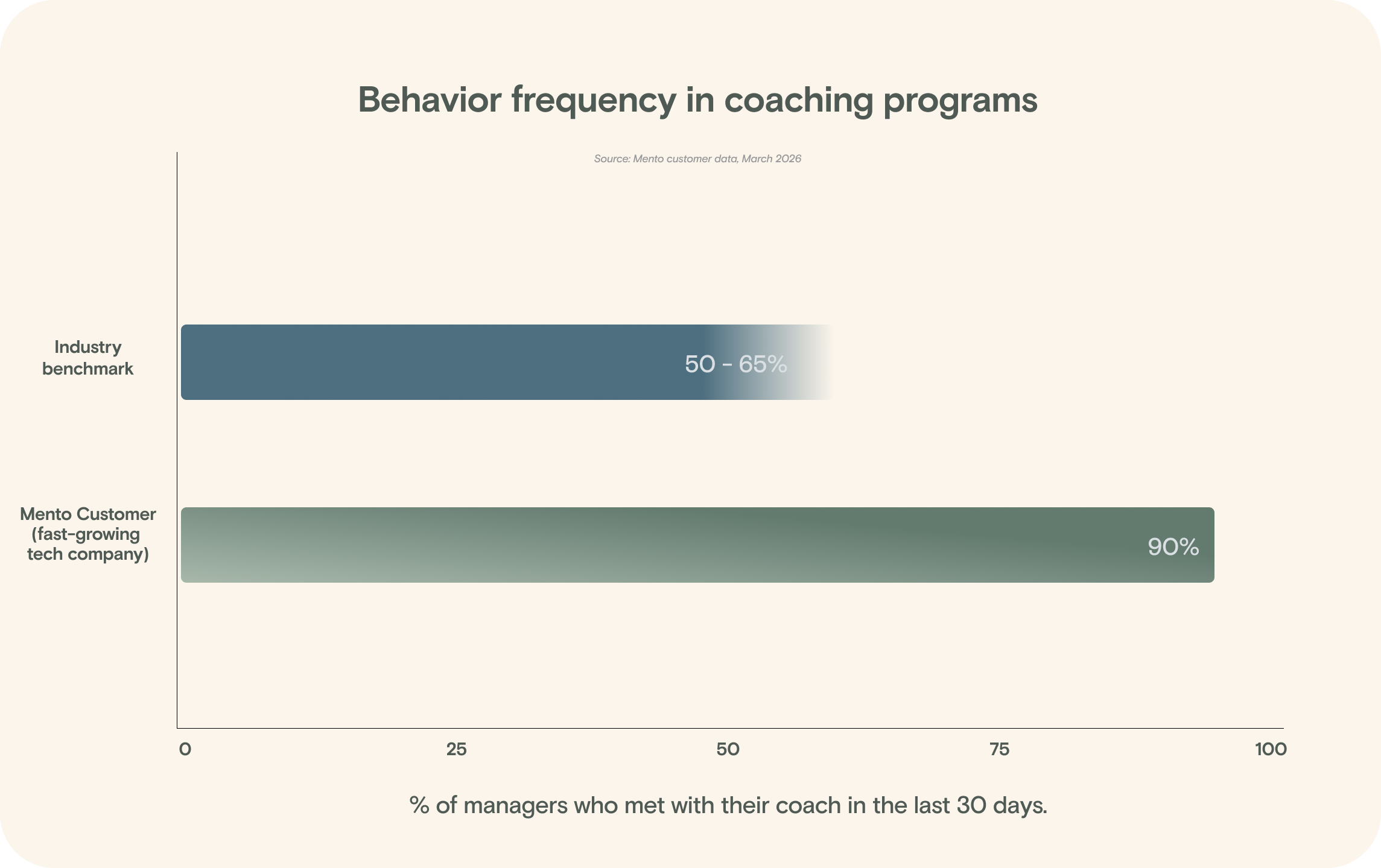
One of our customers, a fast-growing technology company, recently analyzed their Mento coaching program across a cohort of nearly 100 leaders. 90 percent were still actively engaged with their coach ten months in, compared to an industry benchmark for similar programs of around 50–65 percent. The company ran a matched-cohort analysis against non-coached peers using its own internal data. Coached leaders' performance scores improved year-over-year while the non-coached group's scores declined. Teams led by coached leaders had roughly 20 percent lower attrition than the comparison group. The company's own ROI analysis showed positive returns. These aren't satisfaction scores. They're outcomes the business already measures.
The difference between a coaching program that changes behavior and one that doesn't comes down to a few things: whether coaches have real operating experience in the domains they're coaching, how precisely managers are matched to coaches, whether the program sustains across months rather than one-off sessions, and whether outcomes are measured in terms the business cares about.
Three questions for defending your L&D budget
Data alone doesn't change how an L&D function operates. What does is a shift in the questions you ask about your own investments. Here are three worth carrying into your next budget conversation. They cut across every development investment on your menu, and coaching tends to answer them better than the alternatives.
- Which of our current investments are changing behavior, and which are transferring knowledge? Most development programs are built around knowledge transfer. That's useful, but knowledge transfer and behavior change aren't the same thing, and they shouldn't be measured with the same yardstick.
- What happens after the program ends? Transfer of learning is the point where most L&D strategies fail. If the honest answer is "we hope managers follow up," you've found the gap worth closing.
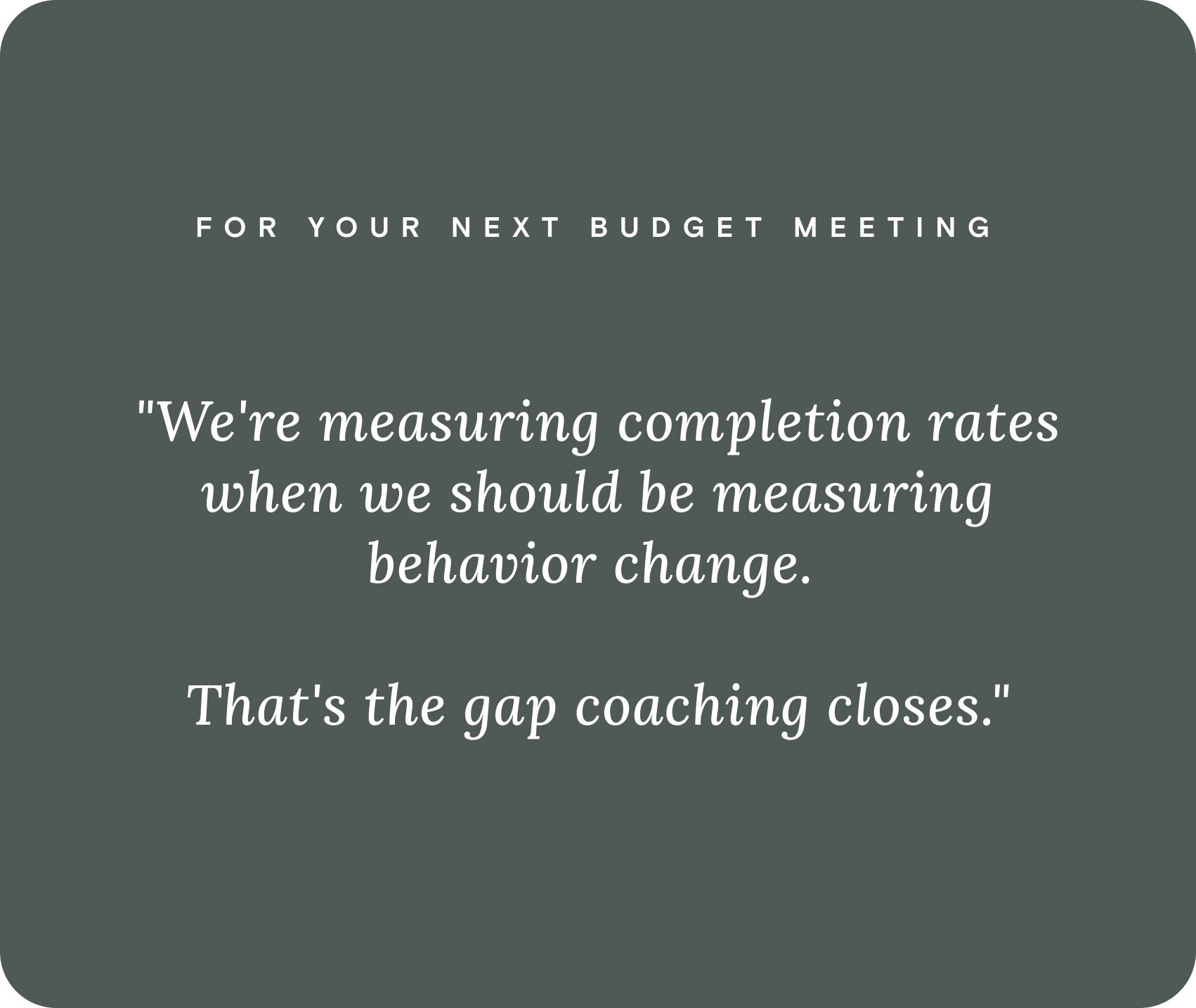
- Are we measuring behavior change, or completion rates? Attendance and satisfaction are easy to report and close to meaningless as indicators of impact. What managers do differently three months later is the number that matters.
Ask these questions rigorously and the case for coaching tends to make itself.
Where this leaves you
Coaching is what makes the rest of your development program work. It's the behavioral mechanism that translates everything else into what managers do on the job. The question isn't whether coaching belongs on your development menu. The question is whether the rest of your leader development spend is working without it.
If you're building this case at your own company and want to see how we approach it at Mento, our team is happy to talk.
Recent articles
Leadership Development
Guide
Guide: Developing Resilient Leaders in 2025
Leadership Development
On-demand Webinar
Building Resilient Leaders in 2025 On-Demand Webinar
Leadership Development
On-demand Webinar
Measuring L&D Outcomes in 2025 On-Demand Webinar
Your coach is your...